Tuesday, March 11, 2014

Hit List: Top 5 Thought-Provoking Dramas

It's time for another Hit List! Listed below (AND in order of my favorite, this time!) are my Top 5 Thought-Provoking Dramas--and some of the thoughts they provoked.

Honorable Mention: Equilibrium (Kurt Wimmer, 2002)


Unfortunately, this film didn't make the cut--but only because I already had five, and only by a VERY SLIM margin.
The Premise: After four world wars, the government turns to science and decides that the underlying factor in all human conflict stems from feelings. Eliminate feelings, and you eliminate conflict. So society becomes a medically regulated conglomerate intent on equality and ratting out your neighbor if you see them exhibiting any sort of emotion at all, or carrying those things that evoke emotion: art, literature, music, etc. The story is told from the perspective of a "Mercenary", the ninja-like police of this blase dystopia. One act of rebellion in a comrade, one challenge from a convicted "transgressor", and the man begins to second-guess what he had blindly accepted--and his world begins to fall apart.

My thoughts: I came across this film because I was looking for some kind of adaptation of "Farenheit 451", a novel I've referenced several times on this blog because I enjoyed it so much. The fact that it starred Christian Bale was a plus.
The film was every bit as striking as the novel it was based on. Incidentally, the film drew on a lot of George Orwell's "1984" for its setting--but luckily (in my opinion), the movie followed the storyline of Bradbury's novel than Orwell's.
I had never before considered how much of human interaction is emotional--but in watching this movie, I saw that people who did not feel rarely even made eye contact. And when a character begins to feel, the effect is almost heart-wrenching. It's as if they're being re-born, experiencing life for the first time. I came away from this film with a new-found appreciation for things as simple as the sunrise. A well-done film with a powerful message and some great stunt sequences!

Poignant quotes: 
"Without love, without anger, without sorrow, breath is just a clock... ticking." (How true this is!)

"You must understand, Preston, that while you - and even I - may not always agree with it, it is not the message that is important, it is our obedience to it. Father's will. Call it faith." (This was poignant to me, not because it is true--but because I am convinced it is an abominable lie... and the fact that it is spoken by a villain trying to excuse himself only confirms this; the message is absolutely vital, as every writer knows; we humans have the capacity to think for ourselves, and the day we give that up is the day we forfeit our humanity)

Now onto the official list, starting with....

5. Extremely Loud and Incredibly Close (Stephen Daldry, 2011)


The Premise: A young boy loses his father on That Awful Day, September ll, 2001. Among his father's things, he finds a key in an envelope labeled "BLACK." He immediately assumes that "Black" is a person who had some kind of connection with his father, and in an effort to stave off the lonliness, the boy embarks on the journey of a lifetime to find the lock that fits the key, to find the person that knew his father, and to reconnect with the best friend that he lost.

My Thoughts: I had wanted to see this movie ever since I discovered it had two of my favorite actors in it, Sandra Bullock and Tom Hanks. Supported by Viola Davis and Max Von Sydow--how bad could it be?

Answer: Extremely Compelling and Incredibly Moving. This movie had me almost in tears. Seriously, Thomas Horn is I.N.C.R.E.D.I.B.L.E. A young boy overcomes his fears (dozens of them) and sets out on an expedition--carefully planned and meticulously researched as only a nine-year-old brainiac can--among the boroughs of New York.
A friend had raved about the book, so I managed to read that first. The style was unorthodox and rather disjointed--very much like the mind of a traumatized nine-year-old who "might have Asperger's Syndrome", as the character claims at one point in the novel.
The acting in this movie is spectacular, and the images are striking. It's almost a documentary of life in New York after the horrendous attack--almost, because the perspective is of one little boy who lost a loving father. We meet dozens of the hundreds of Blacks in New York, and each serves as a small glimpse into the diversity and individuality that makes this country so great.
I came away from this film with renewed patriotism and a resolve to not let my fears hinder me from embarking on my own Great North American Expedition.

4. Harvey (Henry Koster, 1950)
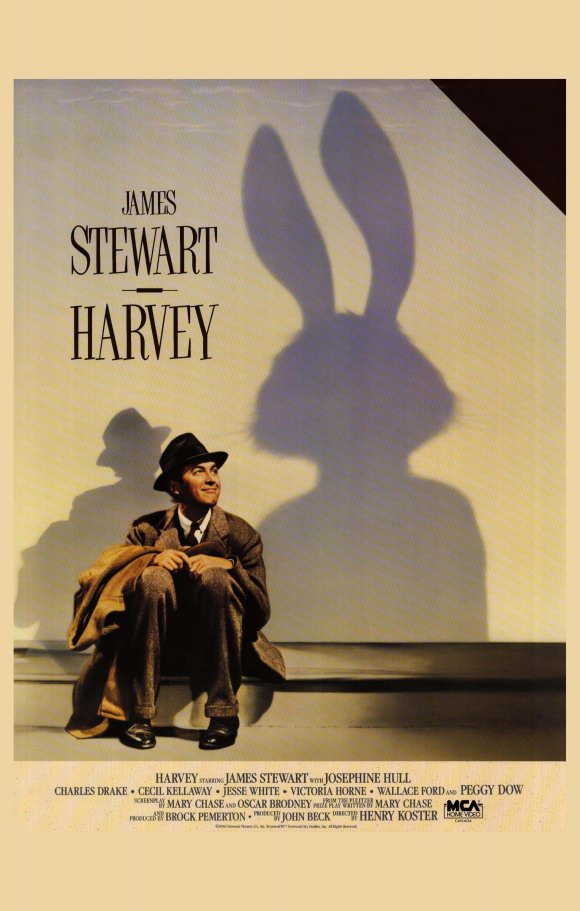

The Premise: Elwood P. Dowd is a pleasant man with a special friend, Harvey--which happens to be a six-foot-tall invisible rabbit that Elwood treats like a visible character. His family, overly concerned for how this is making the people around him feel, wants to get him either adjusted or committed. There is a method for "removing the delusion"--but the effects just might destroy Elwood as the world knows him.

 My Thoughts: Jimmy Stewart at his loveable best. He's a big-hearted, innocent darling in whatever role he plays, and this was one of my favorites. Who wouldn't want to meet Elwood? He's mannerly, polite, affable--the only "hitch" in his existence is Harvey, which his sister seems intent on eradicating because it spoiled her stranglehold on a "normal" life.
This film gave me new insight on the concept of "normalcy." I, myself, am not your average ordinary, and there have been times when I feel rather discouraged and catch myself wondering if I might have found more success in life if I were more "normal."
If I was anything different than what I am, I wouldn't be me. The trick, I realized, is not to be more like everyone else; the secret to a successful, fulfilled life is to learn what is the most effective use of the quirks and skills and proclivities one has in bettering the lives of the people around them.

Poignant Quote: 
"You can either be smart all the time or you can be pleasant. I suggest pleasant... You may quote me."


3. The Island (Michael Bay, 2005)


The Premise: A young man in a sterile, strictly monitored environment begins to question his origins and the world in which he lived. What started out as innocent curiosity spirals into full-blown conspiracy as his inquiries uncover secrets that should have never been realized and problems the powers-that-be never foresaw, launching the young man into an epic journey of personal realization.

My thoughts: Out of all the films on this list, this was probably the one I saw first. I remember watching it, and hiding behind a pillow for some of the gross parts (I never really had any inkling of desire to work in the medical profession, really...)
The pro-life message of this film is probably the most powerful I've ever seen. We see the doctor-who-thinks-he-is-God dehumanizing the clones by calling them by their categorical designation, referring to them as "agnates"; even his clients consider these living, breathing, interacting beings as nothing more than an "insurance policy." Sure, they may be exactly alike as their original on the cellular and molecular level--but their behavior is as distinct as two separate people. The nature of life, too, is considered when the doctor is forced to admit that they had originally wanted the "clones" to be nothing more than an organ breeding ground, but that without "life", the organs died. So the clones had to be developed to actual people, and they did indeed have souls, in spite of his insistence to the contrary. This is an amazing film with some WONDERFUL chase scenes as a couple of the clones escape the facility and must be hunted down or risk exposing the dangerous secret the powers-that-be are hiding from the world.

Poignant Quotes:
"The only thing you can count on is that people will do anything to survive."

"I have discovered the Holy Grail of science. I give life. The agnates, they're simply tools, instruments. They have no souls. The possibilities are endless here. In two years' time, I will be able to cure children's leukemia. How many people on Earth can say that, Mr. Laurent?"
"I guess just you and God. That's the answer you're looking for, isn't it?"


2. Aeon Flux (Karyn Kusama, 2005)


(Not to be confused with the game/TV series, which is, according to the one friend I've heard of who's seen it, NOT recommended!)
The Premise: Society has been reduced by a plague to a community of about five thousand people, living in a perfect Utopia ruled by the family of scientists that provided the "cure" for the disease. But all is not perfect. There is a faction who believes that the ruling family has some hidden agenda, and has made it their mission to expose it and take down the family--and Aeon is the perfect assassin bred to do just that.

My Thoughts: Normally when I see a movie cover with a woman dressed in skin-tight leather, I assume it's going to just be a skanky gore-fest and full of nasty things and I stay away. But with this one, I saw the recommendation on Netflix because of another sci-fi movie I had watched and really like (exactly which one that would be escapes me at the moment), and so I first assessed the trailer before watching it.
I am glad I did. This was an awesomely-done movie. (Some brief partial nudity--but that was just a costuming choice for one scene, not the sole focus of the movie.) Charlize Theron is an absolute gymnast, and the stunt coordinators really put her through her paces. Martin Csokas provides an intriguing counterpart (and target) for Theron's committed assassin, and Johnny Lee Miller (of Elementary and Emma fame) does an impeccable American accent (so much so that I didn't even realize it was him until after I was halfway through the first season of Elementary... Then, of course, I had to go back and watch Aeon Flux again!)
The main thing that struck me about this film was humanity's push for perfection. The people living in this community had quiet lives, perfect lives, and disease-free lives, and scientific advances had made it possible for one to have exactly the body they wished--but there were hidden consequences for trying to cheat death. Is living in absolute comfort and isolation truly living? Should we seek total sterility as the ultimate goal? Or is life meant to be "messy" with experiences we have that are beyond are control--and instead of walling ourselves off, we learn to deal with the messes as they come, and these experiences make us stronger?

Poignant quotes:
"We're meant to die - that's what makes anything about us matter."


1. Nell (Michael Apted, 1994)
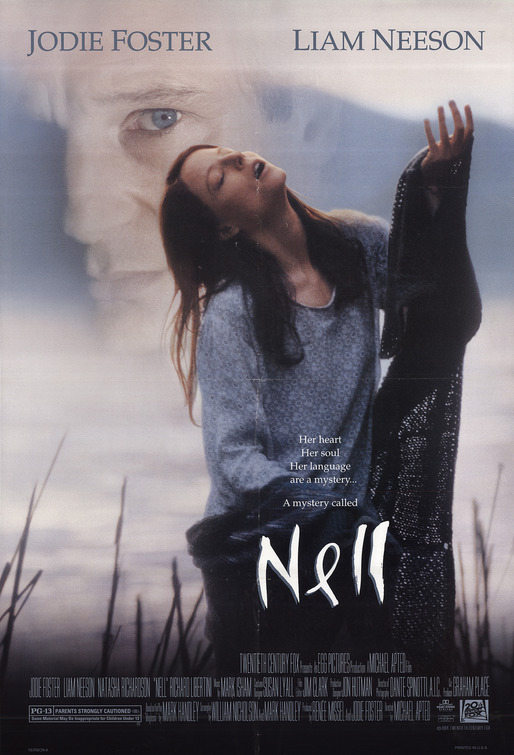
The Premise: A country doctor comes out to a backwoods cabin twenty miles from the middle of nowhere and finds a former stroke patient who died--and her daughter, who had grown up knowing nothing but life at the cabin with her mother, who herself could not do much since the stroke had paralyzed her completely on one side. The daughter had taught herself to speak and to survive from observing her mother, and so developed a language completely alone. The doctor and another medical scientist work together to learn, understand, and gain the trust of a young woman who has lived completely on her own.

My Thoughts: This is without a doubt the only film that I could conceivably describe as "enthralling." I came across it by chance during a Jodie Foster kick--and I was shocked at the depth of this movie. Jodie Foster plays a young woman who has known nothing but life in a cabin at the edge of a small inlet, her own personal paradise where her own garbled sounds have their own meanings. Watching her interact with the doctor (Liam Neeson, in one of the best strong-and-tender roles I've ever seen him in) and fight to make herself understood was truly mesmerizing.
My take-away from this film was that every life is infinitely precious, and some people have a different way of being understood. The girl that most of the surrounding towns regarded as a raging lunatic was every bit a girl who wanted to be loved and smiled at and comforted as much as the little girls who are able to say so. There are those who choose to dismiss whatever they don't understand--ten years down the road, they are no better than they were a decade earlier. But the pursuit of understanding always yields results for those patient enough to see it through.


How about you? What's the most powerful movie you've ever seen? Do you agree with my reviews, if you've seen these films? Let me know in the comments!
 

Saturday, March 8, 2014

Serial Saturday: "Cipherstalker" Part 2

Away up on Fornberg Hill, the master of the house was preparing for his dinner. Always, for one half-hour before commencing the meal, he made it his custom to serenade his dear, departed love. He despondently and passionately drew the bow across the strings of his violin, flanked by two bright lamps that cast their ethereal glow upon the life-size, full-length portrait of his dead wife, Jelilah. As the clock by which Cram Fornberg ordered his life struck half-past-five, the man ceased his music and put his violin back into the velvet-lined case standing upon a table just below the painting. He paused, resting his fingers gently on her perfect, white shoulders, tracing her neck and the shape of her chin with his fingertip. Cram Fornberg sighed.
            “Ah, Jelly!” he moaned, his voice barely piercing the voluminous darkness of the house. “Oh, my darling Jelly!” He gazed into her deep blue eyes, the ones that, though only paint, never ceased to pierce him to the soul. Would that he were Pygmalion, and could give the inanimate life again!
            Cram made his way to the cavernous dining hall. What was the point of having such a massive house, when one lived alone? Cram shook his head; he had not planned on living alone, and this house was his because it was part of the Fornberg estate. Perhaps the prominent British family hoped to establish themselves in America, but as matters stood, every last one of them died out before such a thing could ever happen. Cramwell was the last living Fornberg, and now, with the untimely demise of his lovely wife, he had no hope of continuing the legacy. All that was left was Cram, the multi-million-dollar estate, and the large house with so many locked, unused rooms.
            Cram sat down to a bowl of soup, with a bust of Jelilah set before him on the table. Verily, Jelilah seemed to be the only person of consequence in the house, for after his return Cram spent his time and money amassing memorials to her appearance: paintings, busts, statues, cameos, bas-reliefs, friezes, any art form he could think of in which to represent Jelilah’s likeness, Cramwell set out to have it made, and displayed them throughout the house. He did not feel so lonely that way—yet their presence made him all the more lonely, for what was stone compared to flesh-and-blood?
            Cramwell finished his soup, kissed the bust on the forehead, washed his bowl, and retired to the library, where a large armchair stood in front of the ornate fireplace, where he always built a fire just before five o’clock, so that it would be warm and cozy by six. He laid a vinyl record of the favorite tunes he and Jelilah used to dance to on the turn table, adjusted the needle, and settled into the armchair to read by lamplight one of the stack of cryptology and cipher books he had acquired from the local library.
            There could be little doubt that Cramwell possessed probably every book from the library on the subject of codes, ciphers, and the like, yet he was never harried for late fees, and the most the library staff could do about it was call and inform him if anyone else wanted a book he had. This was because no one wanted to make the long trek up the hill to Cramwell’s house.
            How Cramwell loved those codebooks! Something about the endless array of symbols and substitutions, the air of mystery they lent themselves to—all this appealed to Cramwell. Alone in his massive house, Cramwell sat with the code books on one side and a pile of notebooks on the other—and encrypted everything he could think of. He wrote in the famous Pigpen Cipher, Doyle’s Dancing Men tumbled across the pages of his notebook, he penned his thoughts in perfect Typewriter Cipher, and even the daunting Vignere Cipher was no match for Cramwell’s constant practice. No matter what the code, the key word in Cramwell’s mind was always JELILAH, and it was simple after that to encrypt and decrypt dozens of lines of text. Sometimes, just to amuse himself, Cramwell would pile cipher upon cipher, enjoying the thorough confusion of a perfectly innocuous message this brought about.
            When the record ended, Cramwell put away his books and his notebooks, gave one last caress to the statue of Jelilah standing ever vigilant next to the lamp, kissed the frame of the painting in the front room, and retired to bed.
            Poor Cramwell, with nothing but his statues, paintings, and codes to keep him company! Poor Cramwell Fornberg, so forlorn in that great house! Yet he felt sure that nothing in the world would ever change. The world felt safer, even without Jelilah, as long as he had his predictable, simple, routine to look forward to each day. “Life will go on as it always has,” he constantly reminded himself, “and then I will see Jelilah again.”

            The rain drizzled over Precinct, Connecticut. Karthey curled cozily under the covers of her small bed and watched it trickle down her bedroom window. She listened to the sound of the news her father listened to every night, which her mother called “the Mavis Lullaby.” She closed her eyes and drifted off to blissful slumber.
<<<>>>


Cramwell Fornberg awoke at the stroke of eight, put on his deep-blue dressing gown, and slowly made his way to the front door to collect his paper. He had directed the construction of a chute that led from the mailbox at the gate below right to his doorstep. That way, the paperboy (or person; he never knew who delivered the mail, for all he knew it could be a woman) and Cramwell never had to meet, and Cramwell could acquire his mail in close proximity to his home. Both were invisible to each other.
            Cramwell liked being invisible. He liked it that others could be invisible to him, too. Everywhere he went, no one talked to him (except the cashiers, to tell him how much he owed, even though buying the same things every day meant he knew exactly how much he was spending), no one approached him, and no one so much as looked in his direction. Cramwell was invisible, and he liked it.
            Cramwell picked up his paper and commenced his cozy routine. He brought the day’s paper to the kitchen, where he read the articles aloud to Jelilah’s marble visage over a breakfast of eggs, sausage, and buttered toast. Then he made his way to the sun-room at the back of the house, where he joined a stone statue of a seated Jelilah and read another chapter of her favorite novel. At nine-thirty, he got dressed, grabbed his hat, his cane, and his grocery basket, and made his way down the hill into Precinct.
            Cramwell took care to pull his hat low over his eyes, and keep his head bent toward the ground, knowing that the mere sight of the basket and cane was enough to let people know that Cramwell Fornberg was making his daily public appearance.
            Cramwell entered the cafĂ©, ordered his coffee, and sat in the booth near the window. He almost relaxed in his seat, but something clicked in his mind. He got the same sort of sensation as he did around six o’clock, decoding time; now, of all places, he sensed a code nearby; but where? Cramwell did not move his head as he scanned the vicinity. Tucked inconspicuously in the rack of white paper napkins was a particular napkin with writing on it, a series of forward and backward 3’s and curves.


            Cramwell found himself intrigued, and he did not understand it; he was never intrigued over coffee. Absently, he filled in straight lines among the curves to form letters. A down-stroke at the beginning, a horizontal line connecting the sides of the fourth symbol, another down-stroke for the next symbol: BEWAPE? BEWADE? It made no sense…

BEWARE?

            Cramwell jumped and spilled coffee in the saucer as a chill raced down his spine. He saw traces of more ink inside the napkin. He glanced toward the front of his booth to make sure no one was there as he opened it.

SMOEIL OENWL DSPERT
IAPAA EGTOIH IHTNGT.
804.065

            The letters spun in Cramwell’s vision. What sort of cipher was it? It couldn’t be a direct cipher, as the letters were evenly divided in groups of six (with the exception of the second and fourth words, both of which had only five), and what did the numbers mean at the end? Cramwell had the feeling that the thing he was supposed to BEWARE was contained in the message, but who could have left such a thing, and why? Was his routine, the one thing that he thought would protect him if he dutifully maintained it, in danger of becoming the source of his imminent demise? Or did someone else use this booth besides Cramwell? Was the message intended for them?
            Cramwell tucked the napkin in his pocket and stood. He suddenly felt the urge to go to the library. It was nearly time, anyhow. He caught sight of a red silk tie out of the corner of his eye and shuddered as he left. Red was his least favorite color.

            Clarissa cleaned the table after Cramwell Fornberg left. She brought the cup back to the kitchen.
            “Something’s not right,” she told her colleague, Darla.
            “What do you mean?” Darla asked.
            “There’s coffee in his saucer, and he left a swallow in his cup,” Clarissa showed these things to the other woman.
            Darla looked solemnly at Clarissa, “Something is bothering Cramwell Fornberg. I wonder what it could be?”

            As Cramwell walked down the block to the library, the napkin seemed to burn a hole in his pocket. He rearranged the letters in his head, forwards, backwards, he tried sorting them in alphabetical order and listing all the words he could think of using only those letters: ASPIRE, NIGHT, WISE, TOGETHER, HANDSOME, DESPAIR, DESPERATE, ALONE, NIGHTINGALE, WOE, SMILE, WHISPER, SMELL, WEIGHT, DEATH, GHOST—Cramwell tried to think of something else. What did the numbers mean?
            At last he reached the sanctuary of the library. Surely the books would keep him safe from the haunting words printed on the napkin in his jacket! Cramwell traveled to the Nonfiction section and scanned the shelves for new cryptology and codebooks. A series of numbers on the dirty white sticker adorning every spine caught his eye: 640.829, 640.831, 640.835. Numbers! Just like the napkin! Cramwell hurriedly dug it out and reviewed the numbers on the napkin: 804.065. He dove for the nearest computer console and searched that number in the library catalog. The book to which the number belonged was in the Children’s section, and its title was Hide and Seek With Dick and Jane. What was so special about this book? Would it contain clues to help him solve the message?

            Cramwell found the book and, somewhat self-consciously, began reading.

            “Look! Look! See Dick. See Jane. Jane Will Hide. Dick Will Wait. Look At The Clock! Time To Find Jane! Where Is Jane? Look! A Note For Dick! What Does The Note Say? Jane Is Gone. Where Is Jane? Dick Cannot See Jane. Where Is Jane?”

            Cramwell felt an eerie sensation in his mind as he read words meant expressly for him. He was Dick; what was all this spooky nonsense about “finding Jane”? Moreover, the last few pages of the book were missing! The ones in which Dick finds Jane!
Cramwell distinctly saw the tear marks near the spine of the book where the pages had once been. Who could have done it but the same person who left the note—the “Note For Dick.” What did the note say? How would he figure it out now? Cramwell had no choice but to check out Hide and Seek With Dick and Jane, however uncharacteristic it appeared.
            He moved to the diner to pick up his lunch. The owner, Mrs. Preston, was one of the few who insisted on speaking to Cramwell as if he would speak back.
            “Well, Mr. Fornberg!” She cried as he walked in, popping his usual sandwich, apple, chips, and cookie in a bag for him. “Looks like we’re going to have a nice day, aren’t we now?”
            Cramwell briefly turned his eyes up to Mrs. Preston’s soft, matronly face, but then looked down again, grabbed his bag and walked out.
            “Where is Jane? Where is Jane?” The question hammered in his head. He pulled out the book as he entered the park. A businessman in a black suit and a bright red silk tie brushed in front of him impatiently. Cramwell ignored it, scanning the book intently for some sort of key, or clue as to the answer to the code, the important message that perhaps mentioned who or what this “Jane” might refer to that he had to find.
            “Look At The Clock!” The caption read. Cramwell looked up at the large clock on the far side of the square: the minute hand pointed just beyond 12 o’clock exactly. What was that supposed to mean?
            Cramwell pulled out the napkin with the letters again. “SMOEIL OENWL DSPERT IAPAA EGTOIH IHTNGT.” Perhaps, Cramwell reasoned, the cipher was one that he could solve by aligning the words differently. He tried writing them all in a single column on his lunch bag.

SMOEIL
OENWL
DSPERT
IAPAA
EGTOIH
IHTNGT

            Nothing came of reading the columns of letters, as “SODIEI,” “MESAGH,” etc. Cramwell angrily finished his lunch and—for the first time—rather than return to the library, he picked up his groceries and went straight home.
            Once there, Cramwell brought the bag, the napkin, and the book into the library. He selected three or four of the most comprehensive and likeliest cipher books and scanned through them. Meanwhile, he tried aligning the letters—not just the words—a bit further apart, transferring the message to the notebook instead of the bag.

               S      M     O       E          I       L
            O        E       N      W       L

            Cramwell stopped suddenly as his eyes automatically read the series of letters as the words, “SOMEONE WILL.” That was it! The Picket Fence Cipher! Cramwell hastily translated the rest of the message according to the cipher.

“SOMEONE WILL DISAPPEAR AT EIGHT TONIGHT.”

<<<<Previous                      Next>>>>>

Wednesday, March 5, 2014

Works-In-Progress Wednesday: The Inkweaver Returns!

No, it's not a sequel... I mean I was finally able to finish that chapter that I've been poking at for a really long time! Read and enjoy!

>>>>>
 
The Four Travelers

There were once four simpletons who decided to take a journey.

“My friends,” said the first, “beyond this city there is a large forest. No doubt on the other side of this forest, our fortune awaits us. Let us therefore depart thither, that we may partake of it!”

The other three agreed with the first, and so they departed.

When they arrived at the forest, the four simpletons were met by a Raven.

“Where are you going?” the Raven asked.

“We are going to seek our fortune,” declared the first simpleton.

“We are certain it lies just beyond these woods,” said the next.

“All we must do is keep to the path, and it will lead us right to it,” explained the other.

“Riches and ease; that is how it is done!” trumpeted the last.

“Riches and ease come best and last longest when achieved through toil and honest gain,” said the Raven. “There is a path that runs straight through these woods; do not leave it, or it will be worse for you!”

“We are men in search of fortune, what could possibly go wrong?” scoffed the first simpleton.

“Never trust a Raven, for he will always bode ill,” sneered the next.

“It is only a wood, where is the harm?” taunted the other.

“Nothing can stop us!” maintained the last.

“If you will not heed my warnings, you have only yourselves to blame,” croaked the Raven.


The four travelers continued on their way. Presently, they began to get thirsty.

“My friends,” said the first, “let us find water, ere we die!”

So they left the path through the woods, so great was their thirst, and they came upon a little spring. The Raven followed, and lighted on a boulder.

“Do not drink from this spring!” said the Raven. “It has been enchanted by a witch who lives nearby. All who drink of it are her slaves for life!”

“Isn’t that just like a Raven, to say such wicked things about an innocent little spring!” sneered the first simpleton.

“Can’t you see we are suffering? Let us drink in peace!” said the next.

“Foolish Raven! Don’t you know that modern folk do not believe in old wives’ tales of witches and sorcery?” sniffed the other.

“It is a free country, we may drink where we wish!” huffed the last.

“If you will not heed my warnings, you have only yourselves to blame,” croaked The Raven.


So the four traveling simpletons drank their fill from the spring. When they had slaked their thirst, they grew very hungry. Having no food of their own, they set off still further from the main path to find something to eat. Not far from the spring they discovered a grove of apple trees. One of them said, “These apples look good, and we are famished; let us eat some of them!”

The Raven followed, and lighted upon a branch.

“Do not eat of these trees!” said the Raven. “They are tended by the witch who lives nearby. All who eat of her trees are her slaves for life!”

“Oh-ho! I see how it is! You would have us starve, then!” trumpeted the first simpleton.

“These are public lands; no one owns anything, and everything is free for the taking!” stated the next.

“Where is this witch you speak of? Shouldn’t she put a fence around the trees if she did not want passersby to eat of them?” asked the other.

“Leave off telling us what to do!” cried the last.

“If you will not heed my warnings, you have only yourselves to blame,” croaked The Raven.


Once they had eaten their fill of the apples, the four travelers continued even further into the forest, until they came upon a clearing full of thick, soft grass.

“Friends,” said the first traveler, “we have come a long ways, eaten, drank, and it grows dark. How will we reach our fortunes if we are over-weary from journeying? Let us rest ourselves in this meadow, that we may pursue our riches with full strength.” His companions agreed with him, but the Raven again flew among them, croaking, “Do not lay down in this meadow! It is covered with the enchantments of the witch that lives nearby. She will surely have you in her power if you remain but a moment longer!”

“Here now! We have had quite enough of your dolorous prating!” thundered the first traveler.

“Since we are weary, do we not rest?” demanded the next.

“A little slumber never hurt anyone; it can only do us good,” asserted the other.

“Be quiet, Old Crow!” chimed the last.

“If you will not heed my warnings, you have only yourselves to blame,” croaked The Raven.


They had not rested very long when a beautiful voice filled their ears with a lovely song. All four travelers immediately sat up and rose to their feet as a ravishing young maiden approached the clearing, carrying a jug of water and a basket of apples as she went. She stopped when she saw the four men standing in the field.

“Good morrow, gentlemen!” she called. “What brings you so far into the forest? Do you not know of the witch who lives nearby?”

“We have heard something of her, fair maiden,” said the first traveler, “but we do not believe in such fables.”

The maiden shook her head, and trembled with fear. “Oh no! It is not a fable at all! The hour grows late; soon she will come, and any she finds in this very clearing, she will indeed kill and eat!”

The four travelers began trembling also, and the next traveler asked, “What can we do?”

“Follow me,” said the maiden. “I will lead you to my house, where you may stay until it is safe for you to leave this forest.”

“Thank you, indeed,” said the other traveler.

“What would the world be like without such kind people as yourself?” wondered the last.


The four men followed the young maiden to a small hovel nearby. When all four of them had got inside, the maiden locked the door and barred it. Then she turned around and snapped her fingers, and pop! The four travelers found themselves locked in enchanted cages, for the young maiden had been the witch the Raven had warned them about.

“What is the meaning of this?” asked the first traveler.

“Did you not drink of my spring?” asked the witch.

“But we were thirsty,” protested the next simpleton.

“Did you not eat of my trees?” asked the witch.

“But we were hungry,” objected the other.

“Did you not sleep in my meadow?” asked the witch.

“But we were weary,” complained the last.

The witch clapped her hands, and her true appearance was revealed—an ugly old hag. “You have done all these things, so you are mine!” she said, and with that, she snapped her fingers and disappeared, leaving the four travelers as prisoners in the dark hovel.

The four travelers heard a flurry of wings, and the Raven perched on the windowsill of the hovel.

“Good Raven, tell us what we must do to escape!” begged the first simpleton.

“You had spoken the truth, if only we would have listened!” wailed the next.

“Oh, woe to us! Please help us, dear Raven!” pleaded the other.

“How could we four have been so foolish as to fall into such awful circumstances?” mourned the last.

“You have only yourselves to blame,” croaked the Raven, and he flew away.

 >>>>>>>>>>

“Help! Oh, someone help me quick!”
The cry came from the left branch of the fork. Still Belak hesitated, his dark eyes shifting back and forth between the two paths.
“Please! Is anyone there?”
Before the person—a woman, by the sound of it—could call again, Belak led us down the path.
“Wait!” I called after him, even as Larryn, Greyna, and I fell into step behind him, “How do we know this is the right path? For all we know, the other road is the one we should have chosen!”
Belak didn’t change his pace. “No, it makes sense: there is a person who is stuck here, on the only road that leads into the forest from the side by which we entered. She never passed us, which means she entered the forest from the side we want to reach. She only just began calling for help, which means she must have only recently broke down, and not that she is lost on a road that heads deeper into the forest. This is the right way, Shereya, I just know it!”
I just know it. How I despised that phrase; how can one “just know” anything? I had always been taught that conclusions are the result of careful study and accurate observation and experimentation—none of which Belak had attempted before we went charging down this path.

We had not gone more than a dozen yards down the path before we came to the scene of the accident: a woman sat upon a stump, crying, next to a wagon with its traces snapped and the front smashed as if by angry hooves. She wore a dark dress of fine, shimmering material and dabbed her face with a lace-trimmed silk handkerchief. Her dark hair had been twisted up around her head in true aristocratic style. She looked up at us, and I gasped at the sight of her icy blue eyes and delicate features. If anyone looked like she should be a Wordspinner, it was this woman.
“Oh, praise be!” she sighed when we gathered around her. “I did not know if anyone else used these woodland roads. I have never been to this area before, myself. I was on my way to visit a friend who lives not a mile from here, and my horse suddenly took fright, broke his harness, kicked the wagon, and very nearly killed me before running off into the forest. Tell me, the horse didn’t happen to pass you on the road, did it?”
Belak shook his head and—like the true gentleman he was, offered his hand to help the lady stand. She glanced over the damaged wagon sadly.
“Oh dear, whatever am I going to do? I must reach my friend’s house—but how will I do that with no horse?”
I surreptitiously glanced at her feet as she inspected the hemline of her skirt for mud. She wore a lady’s heeled shoe—completely unsuitable for walking through the mud.
Larryn nudged me from behind. “Should we trust her?” she murmured in my ear.
I carefully watched the lady while Belak inspected the damage to the wagon. There was something familiar about the whole thing that I couldn’t quite place, until I remembered that one of the scenes from my dream last night might have involved a woman and a wagon very like this one. There was just one detail, according to the voices, that would confirm our involvement. The nagging whisper coalesced into a single word that I took to mean some sort of sign that we were on the right path. Onica… Veron…Ca…Ronic… Ver...Ica…
“Pardon, Madam,” I said, “What is your name?”
The dark-haired lady smiled at me. “I am Lady Veronica. What is your name?”
There it was: confirmation. “My name is Shereya. We are here to help you,” I added, for Larryn’s benefit.
Lady Veronica’s blue eyes sparkled. “Thank you!” she said.
Belak turned to her. “Well, if your friend cannot know that you are stuck so nearby, I believe I could pull the wagon myself and get you there safely.”
“Could you?” Lady Veronica blinked in surprise.
In answer, Belak lifted the struts protruding from the front of the wagon and rolled it a few inches to test its weight.
The Lady clapped her hands, “Oh, how lucky I am to have met you all on this road! But what are four youngsters like yourselves doing in this forest?”
Before anyone could spill our entire mission, I answered, “We set out from Aberon yesterday morning and were just on our way to—“
“Carden,” Belak supplied the name of the next town.
Larryn was still glancing at me uneasily. I stepped close to reassure her.
“Don’t worry, I think I saw something like this on the tapestry. If there's any danger coming, a raven will serve as our warning. Just as long as we don’t leave the path, and go straight through the forest without stopping to pick anything from it, we’ll be fine. Lady Veronica is someone we’re supposed to help.”

Belak pulled the wagon—with Lady Veronica riding inside—up the road a short ways, and the road we were on turned right into the doorway of a small mansion situated in a wide clearing. It seemed to be a cross between a small castle and a large house, with wide, ornate walls of stone and many windows to let in what light shone through the trees. No raven had appeared yet, so I believed we were safe.
Lady Veronica alighted and said to Belak. “Thank you, young man; I don’t know what I would have done without your help. Please, if it will not be too much trouble, I would love for you to come in and meet my friends! They will be so glad to meet you!”
Belak glanced at me, and I felt Larryn nudge me again, but I nodded. She wasn’t anything like Morgianna—we had nothing to fear.

A burly man answered the door when Lady Veronica knocked. He was tall and swarthy, with many scars and tattoos, but his face broke into a silver-toothed grin when he saw the Lady.
“Ronni!” he cried roughly. “Good ta see ya! I was beginning to think I wouldn’t lay eyes on you till kingdom come!”
We had all entered behind her. A change came over Lady Veronica. She visibly relaxed as she stepped over the threshold and into the house where she would be safe.
“Ah, don’t worry your poor old head about me, ya great lump!” she suddenly burst out in the same tone he used. “I’ve got me some friends—lonely travelers, they are—and always willing to help poor folk in a jam!”
The burly man closed the door behind us, and I realized only then how incredibly dark the house was, in spite of all the windows we saw.
“Pleased to meet you all,” said the man who had called Lady Veronica “Ronni.”
“My name is Kirk, and any friend of Ronni’s is a friend of mine!” He took each of our hands briefly in his large, rough one—and one by one, as he pulled away, clapped manacles on each wrist before we knew what was going to happen.

I lifted my hands. How had he bound us so quickly? My feet felt weighed down with lead. While Kirk had been “shaking” our hands, “Lady” Ronni had gone and shackled our feet in the same moment! She joined Kirk and surveyed their handiwork: four lonely travelers, trussed up like animals for market-day!
Ronni (I could not even think of her as Veronica anymore) laughed at my dumbstruck expression. “Well, ain’t we so fine now! How lucky I am to have met such fine folk as yourself!” she parodied her own words.
I knew there was something to be said—but I couldn’t think of anything to say. “You—y-you’re no lady!” I spluttered.
Ronni cackled again. She reached up and removed the pin that bound up her hair, letting it fall in stringy waves over her shoulders. “No, but I can do a fair turn, now, can’t I? You’re looking at Ronni Darque, Queen of the Harbor!”
“What do you want with us?” Belak demanded. Larryn and Greyna were both too terrified to speak.
“What do I want?” Ronni spat in his face. “Gold! I want gold and silver! And you lot are going to help me get it!”
Kirk grabbed Belak and Larryn and began dragging them away.
“We will never work for you!” I shrieked. All the dreams—the raven, the name, the wagon—what were they for, if not to deter me from situations like this? Why couldn’t I have foreseen the betrayal! And now we were all going to be killed or left to die in the bowels of this house. How long would it be before my family ventured outside Mirrorvale to look for us? Would they ever suspect that we had gone off and gotten killed?
Ronni fixed me with her ice-blue stare. A malicious grin spread across her face. “Oh, dearie,” she purred, “if I play my cards right, I won’t have to make you work for me. Tomorrow is market-day at the harbor-town; do you know what that means? Do they have market-days in your precious Aberon?”
Market-day… “You mean to sell us?”
Ronni laughed and spread her arms wide as Kirk returned empty-handed. What had he done with my friends?
“That’s what Queen Ronni does, girlie! I recruit strong young bodies like yourselves—and I must say, it’s been ages since I met such strong souls—and sell them to the highest bidder!”
Sold—we were going to be sold! Something within me shriveled as Kirk grabbed my manacles and dragged me down the hall with Greyna. As we passed a window, he paused to fumble with the key to the lock on the door, and I distinctly saw the black shape of a raven landing on the branch of a tree just outside.

Ravens have despicable timing. I hate ravens.

Monday, March 3, 2014

Monthly Reading List: February

It's the first Monday of a new month... so that means another Monthly Reading List!


Rose Under Fire (Elizabeth Wein) 

Verdict: Elizabeth Wein does it again. This time, she focuses on an young American female pilot who gets caught and sent to Ravensbruck, the notorious Nazi concentration camp.
Once again, Wein's sense of voice and her descriptions of the world surrounding her characters can only be described as "VIVID." I can almost taste the sooty, dirty air of the camp, and my own legs ache when Rose meets the "Rabbits", girls who were the forced guinea pigs for German war doctors to experiment and practice on, infecting and carving their legs (at least) on purpose for "observation and education." I held my breath at each attempt at escape the girls staged. So much is stunning and poignant. This is one of the books that I ALWAYS RECOMMEND EMPHATICALLY IN ALL CAPITAL LETTERS. Powerful and enthralling.

First Family (David Baldacci)


Verdict: This was rather an interesting read—especially after I started watching the TV series "King & Maxwell," which aired on TNT and was apparently cancelled as recently as last August on an unresolved cliffhanger after only one season.
Baldacci weaves an interesting mystery and intense drama that pulls characters from several different directions and manages to connect them all, give the readers some informative tidbits as a garnish, and reveal more about his leading characters besides. Finally, we get to learn about the part of Michelle Maxwell's past that I have been wondering about since reading "Simple Genius", and it brings a certain level of closure. "First Family" of course refers to the First Family that is the centerpiece of the novel—but the concept of family is also driven home for King and Maxwell, as the difficulties they face brings Michelle closer to her estranged family, while King observes. A great book, and I can't wait to move on to the next one!

Beautiful Redemption (Kami Garcia & Margaret Stohl)


Verdict: A fitting end to a "Beautiful" series. Garcia and Stohl have woven a tapestry of vivid color that is the Southern life, with all it's traditions and superstitions, connected with nature and weather, it's habits and it's people.
I did skip the book immediately preceding this one, but I felt like most things I could still follow pretty well. Maybe eventually I'll go back and read that third one... Like when I don't have much else that I'm reading... Who am I kidding, when would that even happen?
Beautiful Redemption is the end of the Caster Chronicles, and the theme and beauty of redemption and sacrifice is carried in total clarity through the story, in spite of the dark and gothic context.

Diamond of Darkhold (Jeanne DuPrau)

Verdict: As disappointing as the previous installment, "Prophet of Yonwood" was, I had my reservations when I selected this book. True, "Yonwood" was more an attempt at retconning the events of "Ember" than any kind of character establishment or continuity, but I wondered if it was a portend of what DuPrau's writing had suddenly become.
Thank goodness Diamond of Darkhold was more along the lines of the first two books: a society that begins with electricity and machines and acquires knowledge of the sky and fire and nature. Sort of like history in reverse—and DuPrau presents her case compellingly. I love the characters of Doon and Lina, and the way they come up against the various complications of having to restart life in some cases, and revisit the old way of life in others.
I'm particularly on the lookout for ways in which writers, as Ray Bradbury so wonderfully stated, "touch life often." DuPrau does this with enchanting consistency in three of the four "Ember" novels (excluding "Yonwood") by treating our modern society as an ancient civilization (characters taking the names of cities, but dramatically mispronounce them: Chicago becomes "Skago", Washington becomes "Washton", etc.) and referencing circumstances and concepts in a way that makes complete sense to us yet crafts a whole different frame of reference for the characters.
This was a wonderful end to a series that should be regarded as a trilogy. An enjoyable read, for sure!

D is for Deadbeat (Sue Grafton)


Verdict: Boy, am I enjoying this series! Kinsey is a great character who finds herself in all sorts of colorful situations. Her tenacity often gets her almost killed, but somehow she manages to outwit her attackers and defy their murderous attempts.
Kinsey is used to having a straightforward case—but then she finds out that the man who "hired" her is a con artist and he becomes her target instead of her client. I think there might have been one or two "indelicate" scenes in this installment, but nothing to detract from the story as a whole!

E is for Evidence (Sue Grafton)

Verdict: Oh, Kinsey! First a mysterious deposit, then incriminating (and missing) evidence, a few well-timed rumors, and WHAMMO!! This series' main P.I. finds herself under suspicion for accessory to the crime she's supposed to be investigating! What gives? Not Kinsey! Slightly more graphic than the last one, but Grafton keeps it tactful and drives the intrigue so hard I was guessing the whole time.

Matched (Ally Condie)

Verdict: True, when a high-school girl is raving about a book whose whole catalyst is a teenage love triangle, one has every right to be skeptical. The kind of self-imposed "angst" that riddles teen novels today is most often described with terms like "smut", "fluff", and (most deplorable of all) "slash."

I don't read smut or slash if I can help it, and I need a DARN GOOD REASON to go anywhere near fluff. Don't get me wrong, I love a good, hearty romance—but that's another category from any of those three.

So why am I reading "Matched"? Why, if I claim these standards, would I subject myself to a book that states as it's premise the following: (paraphrased)

Cassia Reyes has grown up believing that The Society has calculated and regulated everything for the optimal life, from the kind of clothes you wear and the leisure activities you choose to the very hour of your death. So when the program created by the Society matches her with Xander, she believes without question—
Until the program glitches and she glimpses another, less familiar face, the near-Outcast Ky.
Was it fate? Will she go with the predictable Xander, or can Cassia allow herself to reject what others say and choose Ky on her own?


Just so we're clear, I would almost consider this "smut." I certainly expected it to be along the same lines as the HEINOUS CRIME AGAINST LITERATURE that is "The Selection" by Kiera Cass (which also features a love triangle along the same lines, but the characters are in no way anywhere near the maturity level of Cassia, Xander, and Ky!)—

Thank goodness I was wrong. Ally Condie defied my expectations and managed to craft a novel of very pertinent social observations at its core and not driven just by the romantic, flimsy "smut" of the triangle. I hope to be reading the sequel next month, and I look forward to giving another good report!

Raven's Gate (Anthony Horowitz)

Verdict: Okay, so after the end of the Alex Rider novels, the triumph of "House of Silk", and the dismal failure of the Diamond brothers, I finally got my hands on what I hoped would be something more like what I liked about this man's style.
The premise was certainly interesting enough: a boy in the foster system who gets sent to this creepy English town where supernatural forces are at work, and he discovers supernatural powers in himself that he never imagined, and oh by the way, he's also destined to save the world if the forces of evil don't manage to kill him. With a moniker like "The Gatekeeper Series," how bad could it be?


Answer: bad. GOSH DARN IT, ANTHONY! The book held water right up till chapter 2, when the main character arrives at the town and you immediately know that this strange woman he's living with is up to no good, and the whole town is bewitched and they're reciting the Lord's Prayer backwards and people are dying and getting sucked into time warps and drinking snakesblood and there's hellhounds and he doesn't let them bleed him but there's his blood on the knife and it's enough to open the demonic (and eponymous) Raven's Gate and release all manner of pestilence and darkness. I stuck with it in the hopes of SOME redeeming factor, but from one cover to the other there was pretty much nothing but disappointment, cringing, and heartbreak. Piffle.

Yay! Now that's done, I can finally crack open that stack that has been calling my name for a couple weeks now.... See you farther Upstream!
*(all images found on google.com)


Saturday, March 1, 2014

Serial Saturday: "Cipherstalker", Part 1

The town of Precinct, Connecticut was, on the whole, an unassuming town. The citizens just plain did not make assumptions about anybody—but in a town like Precinct, Cramwell Fornberg generally didn’t fall under the category of “anybody” in the minds of everyone else.
Those who knew him from when he and his wife first moved to Precinct as newlyweds said that Cramwell and Jelilah were the happiest pair of people on earth. Cram must have been a rich man, because he bought a mansion on a hill overlooking Precinct, and there he and his bride lived, coming down periodically to participate in social events, buy food and furniture, or to spend long hours in the Precinct Library, for both were voracious readers.
Later on, when Cram and his wife left for the seaside and Cram came back alone, rumors began to spread that he had killed her. Her body was never found. Two things were certain about the odd man’s return: he had a very large suitcase (large enough for a body, people said) strapped to the top of his car, and a few days later, a large box arrived at Fornberg Hill. This only served to confirm the rumors in the minds of the townsfolk.
The oddest thing was that Cram didn’t seem to care what everyone thought. He continued the life he had led with “Jelly” just exactly as if she was still with him, though he never socialized anymore. Nowadays, it was only the cafĂ©, the diner, the park, the library, the grocery store, and his mansion. It was always the same: the same places every time, the same times every day, the same days every week. People began to say that Cramwell forfeited his soul when he killed his wife, and their children grew up believing that Cramwell Fornberg was the world’s only flesh-and-bone robot, who kept to his “programming” and did not stray for any reason. Cramwell became the man who never spoke to anyone, never even needed to look up from the ground as he went about his daily habits.
As time wore on, Fornberg Hill grew a shroud of mystery and horror about it. Those who believed Cramwell killed his wife were the sort who also said that he must have cut her body into pieces and hid them around the house. Others said he had the body shipped to his door afterwards in that large, long, package, and he kept it preserved in a glass tomb. Never mind that the large suitcase was the same one he left with; there must be some other explanation, however gruesome it might seem. Occasionally on still, clear, nights, a gentle, mournful wailing is heard. Some say it is out of despair and loneliness over losing his wife. Others speculate it is his guilty, shame-filled mind that tortures him in the light of the moon. Nobody ever asks him. Cramwell Fornberg is the town enigma; living, breathing, walking misery personified.

Then one day, a series of peculiar events occurred which changed Cramwell’s life forever.
>>>>>>>>>>

“Heads up!”
“I’ve got it!”
“Too high! Jump! Don’t lose it!”

Karthey Mavis watched in horror as the baseball sailed up over the high, unkempt hedges surrounding the base of Fornberg Hill and vanished. Her brother Derrik extracted himself from the hedge where he’d landed after the failed jump as if the very leaves were poisonous.
“Great job, dimwit!” Derrik’s friend Gavin—the one who had thrown the ball—spat in frustration.
“It’s your fault anyway, Gavin!” Derrik retorted, “You were the one stupid enough to throw the ball toward that hedge, whether you meant it to go over or not!”
“Guys!” Karthey interrupted the argument and threw her glove like a gauntlet between them. “Fighting won’t bring the ball back, and I know neither of you have the guts to go get it yourselves.”
Derrik and Gavin glanced at each other. Derrik shuffled uncomfortably and glanced at the hedge out of the corner of his eye. “I wonder how many balls and kites and runaway pets the old coot has got in there, anyway,” he remarked.
Karthey shivered and checked her watch. “It’s almost five,” she observed ominously.
Gavin looked at the frightened faces of the siblings, “What happens at five?”
Derrik’s eyes flashed a terrible gleam as he stated, “Dinner.”

Karthey tugged at the scarf around her neck and nervously twitched at her lucky coral bracelet as she began walking away, her booted feet taking long strides, to put as much distance between herself and the hill as possible in the shortest amount of time.
“Wait, you guys,” Gavin begged, “What do you mean dinner?”

In answer, a thin, sibilant, pulsing wail erupted from the house at the top of the hill. Gavin found himself rooted to the spot as the very sound of the ascending and descending tones threatened to tear his insides from his body.
He turned back to the Mavises, who had stopped to wait for him. “What’s that?” He whispered hoarsely.
That is Cram Fornberg, the man who lives in that house,” Karthey answered.
“They say he has his dinner at five-thirty, but half an hour before that,” Derrik paused for a truly chilling effect, “The Cram sings.”
Gavin listened to the smooth, plaintive, haunting tune. “He…sings?” he repeated incredulously.
Karthey grabbed Gavin’s hand and the trio returned to the safety of downtown Precinct. “My brother is one of those people who believe that Cram killed his own wife, and as punishment, got turned into a monster who eats people and animals.”
“Come on, Karthey!” Derrik tried to reason with his sister, “No human ever sounds like that! If he isn’t the monster, my guess is he keeps one for a pet!”
“All you know is that every day at five o’clock the wailing starts!” Karthey snapped back. “The rest is pure conjecture!”
“How long has it been since anyone has seen this guy?” Gavin asked as they walked past the shops and businesses of Precinct, headed for the residential area of town.
“An hour,” Karthey replied simply.
“Wait, really?”
“More or less,” she stopped, slightly irritated, and proceeded to explain, “Cram Fornberg has a system to his day: he comes down to the cafĂ© at ten o’clock, sits in the corner booth for half an hour, then goes to the library till noon, walks across the Square to the diner, gets his lunch, sits in a bench at the back of the park to eat it, then at one-thirty he’s back in town, at the library. He stays in the library till four, goes straight to the grocery store for his daily necessities, and disappears up the Hill again. It’s been an hour since anyone has seen him.”
Gavin shook his head, “Then where did this monster idea come from?”
Karthey shot a glare at her brother as she said, “That is from the people who have grown so accustomed to Cram’s system that they create schedules of their own by which they can avoid the sight of him. The whole town’s done that,” Karthey bit her lip and hung her head, “even me. That way, it feels like he doesn’t exist, or he’s some sort of invisible ghost, because we know he’s there, but we don’t see him.” She cocked an eyebrow at her friend, “You seriously have never heard of him?”
Gavin shrugged, “Well, I was away at college in Maine, remember? I just came back this summer. I guess, growing up around here, I had no idea that everyone acted so weird. Then, after being at college for a year, and coming back here—“ Gavin shook his head, “So that’s why everyone does what they do? Because of this Cram-thing?”
“He’s not a thing!” Karthey burst out angrily. “He’s a person! Dad says he’s a very, very, very lonely, very troubled person!” Her chin clenched, and she looked like she was about to cry.
“If you’re so sympathetic,” Derrik taunted, “Why don’t you go visit The Cram? Like ‘Beauty and the Beast’—literally!”
“Shut up, Derrik!” Karthey snapped at her brother.
Gavin raised his hand, “Okay, well, I’ve got to get back home now. See you guys tomorrow!” He cast one last furtive glance over his shoulder at the Hill and departed down his block.

Karthey left her brother standing on the sidewalk without a word. Derrik instantly felt sorry; as much as he teased his sister, she meant the world to him.
“Karthey,” he ran after her, “I’m sorry; I didn’t mean to hurt your feelings!” He looked her in the eye sincerely. “I’d feel awful if you went up Fornberg Hill on my account. Promise me you won’t do it?”
Karthey roughly wiped the tears from her hazel eyes and sniffed, “Why would I do anything so stupid?” she asked her brother. “You know I wouldn’t leave you, Derrik, not without a good reason.” She rolled her eyes and managed a smile, “And since when have I done anything purely on your account?”
Derrik sighed with relief at his sister’s change of attitude. “Let’s get home together,” he proposed.
“It’s dinnertime,” Karthey reminded her brother teasingly, grinning. Together, brother and sister entered the house where loving parents and a warm meal awaited them.
^^^^^^^^